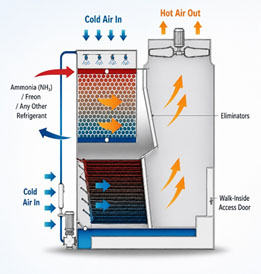

Evaporative Condenser - an overview
An evaporative condenser is a condenser integrated into a cooling tower which rejects the latent heat of condensation of refrigerant (Ammonia/Freon) through a coil to the surroundings by means of evaporation. Water sprayed onto the coil exchanges heat with the refrigerant. A small quantity of water is evaporated into the air thereby cooling the remaining water cascading to the basin at the bottom. Post evaporation the saturated air passes through the drift eliminators and then forced out using a fan.
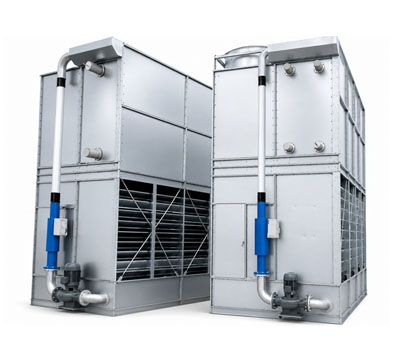
Footprints – Process Cooling
Dairy & Milk
Processing
Seafood &
Fisheries
Food &
Beverage
Meat & Poultry
Processing
Chemical
Processing
Polymer &
Plastics
EPC & Industrial
Projects
Pharmaceuticals
& Pigments
Power, Metals
& Steel
• Wide Range of Thermal Duties - Ideal for Ammonia / Freon condensation with low approach
• Retro Fit & Replacement— Single air inlet models are designed and fit into the existing system.
• Selection Customization — can optimize footprint and least Power requirements to suit project requirements, large product range & Customized Material of Construction*.
• Largest sales & support network across India
EVAPORATIVE CONDENSER V/S CONVENTIONAL SYSTEM
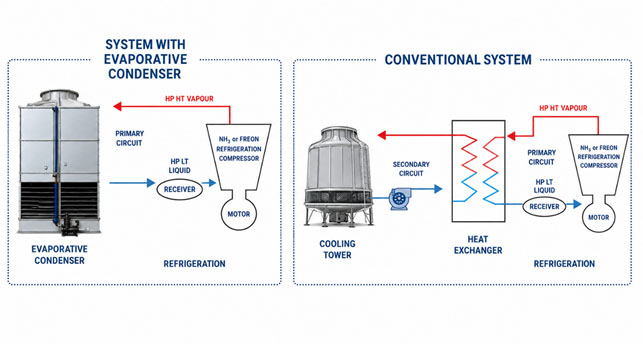
Conventional System:
Uses a heat exchanger, cooling tower, pumps, and piping to reject heat. This increases complexity, scaling risk, maintenance, and energy losses.
Evaporative Condenser:
Combines heat rejection and condensation in a single unit, eliminating the heat exchanger and secondary circuit. This improves efficiency, reduces maintenance, minimizes scaling, and lowers operating costs.
OPERATING PRINCIPLE
The refrigerant flows through the coil of the evaporative condenser.
• Heat from the refrigerant is rejected through the coil tubes.
• Part of the heat is removed directly by the downward induced air and discharged to the surrounding.
• Rest of the heat is rejected to the water cascading down over the tubes.
• Simultaneously, air is drawn in through the air inlet louvers at the base of the evaporative condenser.
• A small portion of the water is evaporated which removes the heat. The warm saturated air travels through the drift eliminator & discharged by the fan to the surrounding, thereby reducing drift water loss.
• Post heat exchanged, the condensed refrigerant flows to receiver tank.